How to Open a Swig Franchise in 2026: Real Costs, Requirements, and Step-by-Step Process
If you’ve searched “how to open a Swig franchise,” you’ve probably already hit a wall: most of the guides online quote 2024 numbers, and a few even suggest you can buy in with $100,000 in liquid assets. That’s not accurate anymore. Swig has quietly become one of the more selective franchise systems in the food and beverage space, and understanding that shift will save you a lot of wasted time.
Here’s what’s actually true right now, what it costs, who qualifies, and how the process works from first inquiry to grand opening.
Swig Franchise Opening Overview
- Swig has shifted from broadly courting franchisees to targeting experienced multi-unit restaurant operators with $2.5 million in liquid assets and 10+ existing QSR units.
- Total investment ranges from about $505,000 to just under $2 million per location, with a flat $39,500 franchise fee.
- Ongoing costs include a 7% royalty plus a 2–3% marketing contribution.
- New franchisees are generally expected to commit to a 10-unit development plan, not a single store.
- The brand is growing fast — 150+ locations and multiple 13-to-38-unit development deals signed in 2026 alone — which is good news for the brand’s trajectory, but it raises the bar for who can realistically get in.
What Is Swig?
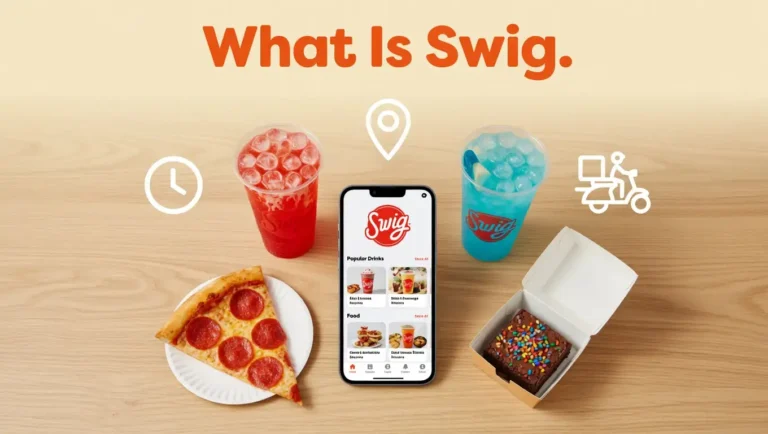
Swig is the drive-thru beverage chain credited with popularizing the “dirty soda” classic sodas like Dr Pepper or Coca-Cola mixed with flavored syrups, cream, and fruit purée. Founder Nicole Tanner opened the first location in St. George, Utah, in 2010, and the brand has since added cookies, pretzel bites, and energy drink-style “Revivers” to the menu. Swig is backed by Savory Fund, a restaurant-focused private equity group, which has fueled its recent growth.
| Fact | Detail |
|---|---|
| Founded | 2010, St. George, Utah |
| Headquarters | American Fork/Lehi, Utah |
| Franchising since | 2022–2023 (early franchise deals began appearing around 2023) |
| Locations | 150+ across 16–17 states as of mid-2026 |
| Signature product | Dirty soda |
| Store footprint | As small as 800–870 sq. ft. |
| Format | Drive-thru, end-cap, and freestanding |
Is Swig Still Franchising in 2026?
Yes, but not the way most articles describe it. This is the single most important thing to understand before you go further.
When Swig first opened franchising around 2022–2023, it was courting a broader range of buyers, and early write-ups (some still circulating online) cite liquid asset requirements as low as $100,000–$300,000. That’s outdated. Swig’s current franchising page now lists qualification requirements aimed squarely at established multi-unit restaurant operators:
- $2.5 million in liquid assets
- Currently owning and operating 10 or more quick-service or fast-casual franchise restaurants in your target market
- A demonstrated track record: 4-star-plus online reviews and positive references from your existing franchisors
- A commitment to develop at least 10 Swig locations, opening 2–3 new stores per year
- Strong local real estate expertise to secure high-traffic sites
Recent deal announcements back this up. In 2026 alone, Swig has signed multi-unit development agreements for 38 units in Kansas City, 25 units in South Florida, and 13 units in Chicago’s southwest suburbs — all with groups that already operate dozens of other restaurant locations (Dunkin’, Baskin-Robbins, Zaxby’s, and similar brands). Swig’s leadership has publicly said it’s “actively seeking qualified multi-unit operators,” not first-time restaurant owners.
What this means for you: if you’re a first-time entrepreneur or you operate one or two locations of something else, you likely won’t clear Swig’s current bar. That’s not a reason to stop reading — the cost and process information below still matters if you’re evaluating the brand, comparing it to competitors, or building toward multi-unit qualification down the road.
How Much Does a Swig Franchise Cost?
Cost figures vary slightly depending on which FDD year a source pulled from, but they cluster in a consistent range.
Initial Investment Breakdown
| Expense Category | Low End | High End |
|---|---|---|
| Initial Franchise Fee | $39,500 | $39,500 |
| Real Estate Improvements | $260,000 | $1,415,000 |
| Equipment, Décor & Supplies | $78,500 | $245,000 |
| POS & Technology | $12,000 | $36,000 |
| Initial Training & Travel | $3,000 | $10,000 |
| Inventory, Uniforms & Opening Materials | $12,500 | $31,000 |
| Grand Opening Assistance & Marketing | $10,000 | $45,000 |
| Additional Funds (3 months) | $30,000 | $80,000 |
| Total Estimated Investment | ~$505,000 | ~$1.98 million |
The spread is wide mainly because of real estate: a ground-up freestanding build costs dramatically more than retrofitting an existing end-cap drive-thru space. Some more recent FDD summaries push the top end even higher (close to $2 million) once construction and rent-related add-ons are included, so budget toward the higher figure if you’re planning a new build rather than a conversion.
Initial Franchise Fee
The franchise fee itself is consistently reported at $39,500 across every source, regardless of investment size. This is a flat fee per unit, so a 10-unit development agreement means committing to that fee multiplied across your build schedule, not a one-time cost.
Ongoing Swig Franchise Fees
Once your store is open, plan for these recurring costs:
- Royalty fee: 7% of gross sales
- Marketing/brand fund contribution: 2–3% of gross sales
- Technology fee: roughly $400/month per location
- Standard operating costs: rent, labor, inventory, utilities, maintenance
At a 7% royalty plus a 2–3% marketing contribution, Swig franchisees hand over roughly 9–10% of top-line revenue to the franchisor before covering any other operating expense — worth building into your financial model early.
Swig Franchise Requirements (Financial & Operational)
To summarize the current bar for entry:
Financial requirements:
- $2.5 million in liquid assets
- Strong existing banking relationships and demonstrated ability to secure financing for a multi-unit build-out
Operational requirements:
- Currently operating 10+ QSR or fast-casual franchise locations in your market of interest
- 4-star-plus average online reviews across your existing brands
- Positive references from your current franchisors
Development requirements:
- Commitment to develop a minimum of 10 Swig locations
- Ability to open 2–3 new stores per year
- Local real estate expertise to secure prime, high-traffic sites
There is no published minimum net worth figure on Swig’s own site, though some third-party franchise directories still list older figures (in the $500,000–$1.5 million range) left over from before the model shifted treat those as historical, not current.
How to Open a Swig Franchise: Step-by-Step
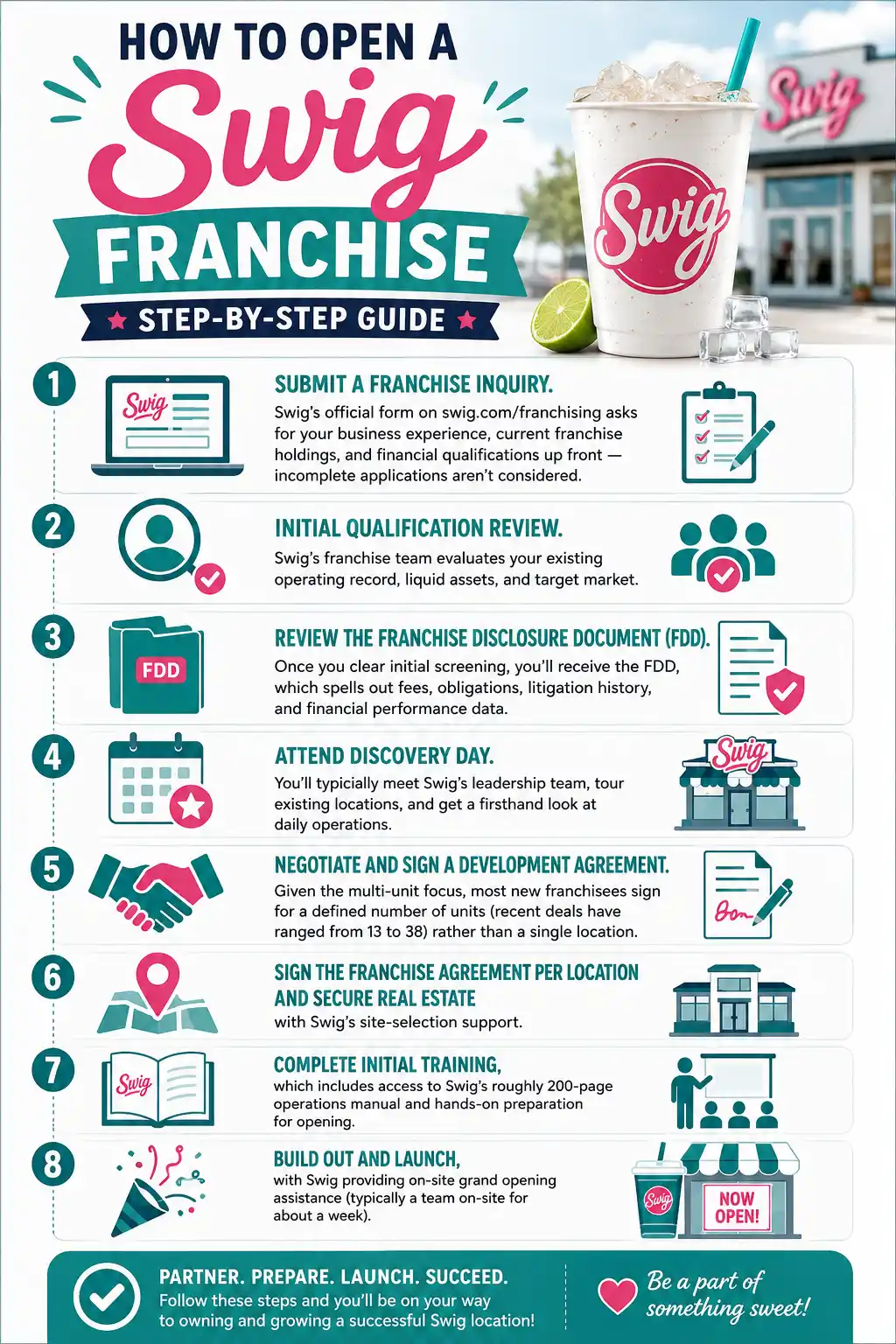
- Submit a franchise inquiry. Swig’s official form on swig.com/franchising asks for your business experience, current franchise holdings, and financial qualifications up front incomplete applications aren’t considered.
- Initial qualification review. Swig’s franchise team evaluates your existing operating record, liquid assets, and target market.
- Review the Franchise Disclosure Document (FDD). Once you clear initial screening, you’ll receive the FDD, which spells out fees, obligations, litigation history, and financial performance data.
- Attend Discovery Day. You’ll typically meet Swig’s leadership team, tour existing locations, and get a firsthand look at daily operations.
- Negotiate and sign a development agreement. Given the multi-unit focus, most new franchisees sign for a defined number of units (recent deals have ranged from 13 to 38) rather than a single location.
- Sign the franchise agreement per location and secure real estate with Swig’s site-selection support.
- Complete initial training, which includes access to Swig’s roughly 200-page operations manual and hands-on preparation for opening.
- Build out and launch, with Swig providing on-site grand opening assistance (typically a team on-site for about a week).
Realistically, expect 12–18 months from initial inquiry to opening your first location, and longer if you’re building from the ground up rather than converting an existing pad site.
Next step: If you meet Swig’s current qualification bar, submit an inquiry directly through swig.com/franchising and request the current FDD before committing any funds. If you don’t yet meet the bar, it’s worth revisiting in a year or two as you build your operating portfolio or comparing Swig against beverage franchises still open to single-unit, first-time buyers.
How Much Do Swig Franchise Owners Make?
Swig does not publicly disclose average franchisee profit margins, and the company hasn’t published unit-level profitability data outside of its FDD. What is disclosed:
- Average unit-level gross revenue has been reported in FDD summaries in the $975,000–$1.4 million range, depending on the year and which stores are included in the sample.
- Some individual top-performing locations have reportedly exceeded $1.5 million in annual sales.
- Net profit margins for quick-service beverage concepts like Swig’s typically fall in the 15–25% range industry-wide, though Swig’s own FDD Item 19 is the only reliable source for brand-specific figures request it directly rather than relying on third-party estimates.
Because Item 19 disclosures and reported averages vary by FDD year, don’t treat any single number here as guaranteed; ask for the current FDD’s Item 19 section before making financial decisions.
Swig Franchise Territory & Support
Support provided:
- Real estate and site selection assistance
- Preliminary design and layout planning
- Initial training for up to three team members per location
- 7-day on-site grand opening assistance
- Ongoing brand, menu, and technology updates
- National marketing program participation
Territory protection: Swig does not grant exclusive territories. Franchisees typically receive a defined area (commonly described as around a two-mile radius), but Swig retains the right to operate or authorize other outlets including non-traditional formats within or near that area, and to sell directly to customers in your territory through its website, app, and social channels without compensating you.
This is worth discussing directly with Swig’s franchise team and reviewing carefully in the FDD before signing.
Pros and Cons of Owning a Swig Franchise
| Pros | Cons |
|---|---|
| Strong brand recognition and social media following | High total investment, especially for ground-up builds |
| Simple, scalable operating model (no complex kitchen) | Now geared almost exclusively toward multi-unit operators |
| Backed by an experienced restaurant private equity group (Savory Fund) | Non-exclusive territory rights |
| Small physical footprint lowers real estate risk per unit | Limited franchise track record (franchising only since ~2022–2023) |
| Strong reported unit-level revenue | 7% royalty + 2–3% marketing fee reduces net margin |
| Active national expansion momentum in 2026 | Full FDD financial performance data isn’t publicly available online |
Swig vs. Other Beverage Franchises
| Swig | Typical Coffee/Beverage Franchise | |
|---|---|---|
| Initial investment | ~$505K–$1.98M | Often $100K–$500K |
| Franchise fee | $39,500 | Often $25K–$45K |
| Royalty | 7% | Typically 5–6% |
| Buyer profile required | Experienced multi-unit operators only | Often open to first-time owners |
| Footprint | 800–870 sq. ft. | Varies widely |
Swig sits at the higher end of the beverage-franchise investment spectrum, and — unlike many of its peers — it’s currently not the right fit for someone buying their very first franchise.
Who Should (and Shouldn’t) Pursue a Swig Franchise
Good fit if you:
- Already operate 10+ QSR or fast-casual locations
- Have $2.5 million or more in liquid assets available for this specific investment
- Want to add a fast-growing, high-visibility brand to an existing multi-brand portfolio
- Have in-house real estate and construction expertise
Not a good fit (right now) if you:
- Are a first-time franchise buyer
- Have liquid assets under roughly $1 million
- Want a single-location, owner-operator business
- Aren’t prepared to commit to a 10-unit development schedule
If you fall into the second group, it may be worth tracking Swig’s growth for a few years, building your operating track record with a more accessible brand first, or looking at beverage concepts still open to single-unit buyers.
FAQs
Is Swig currently accepting new franchisees?
Yes, but Swig is prioritizing experienced multi-unit operators with existing QSR portfolios rather than first-time franchise buyers.
How much does it cost to open a Swig franchise?
Total initial investment typically runs from roughly $505,000 to just under $2 million per location, plus a $39,500 franchise fee.
What is the Swig franchise fee?
$39,500 per location, consistently reported across recent FDD summaries.
What is Swig’s royalty fee?
7% of gross sales, plus a 2–3% marketing/brand fund contribution.
What net worth do I need to open a Swig?
Swig’s own site specifies $2.5 million in liquid assets rather than a separate net worth figure; older third-party sources citing lower thresholds reflect the brand’s earlier franchising phase and are outdated.