Is Swig a Franchise? The Real Story Behind Every Dirty Soda Cup
Swig is a franchise, but it wasn’t always one. The Utah-based dirty soda chain spent over a decade as a fully corporate-owned company before opening its franchise program in 2023. Today it runs on a mixed model: some locations are owned and operated by Swig itself, while others belong to independent franchisees who’ve signed on with Swig Franchising, LLC. Here’s exactly how that split works, what it costs to buy in, and who actually qualifies.
Key Takeaways
- Swig began franchising in 2023, after 13 years as a corporate-only chain.
- The brand now has more than 150 locations across 16 states.
- Franchised stores make up a growing share of new openings, alongside company-owned units.
- Startup costs run roughly $504,900 to over $1.98 million, depending on the source and location type.
- Swig only works with experienced, multi-unit operators — it’s not a fit for first-time business owners.
- The brand is majority-owned by the Larry H. Miller Company, with the Savory Fund holding a minority stake.
How Swig Became a Franchise?
Swig started as a single drive-thru soda stand in 2010, opened by founder Nicole Robison (then Nicole Tanner) near Dixie State University in St. George, Utah. The idea was simple: take familiar sodas like Dr Pepper and Coke and “dirty” them up with flavored syrups, fruit purees, and cream. It caught on fast, especially in Utah, and Swig spent its first decade as a corporate-owned regional chain.
That changed in November 2022, when Swig was sold to the Larry H. Miller Companies with the Savory Fund taking a minority interest. Backed by new ownership and capital, Swig announced in 2023 that it would open 25 corporate-owned locations and simultaneously launch a franchising program. That same year, Arkansas got the brand’s first-ever franchised location, in Rogers.
Since then, growth has been fast. By 2026, Swig had signed multi-unit development deals stretching from Chicago’s southwest suburbs to Southern Florida to Colorado Springs, most of them franchise agreements with experienced multi-unit restaurant operators rather than first-time entrepreneurs.
Franchise vs. Corporate-Owned: What’s the Split?
Not every Swig you visit is franchised. The company continues to open and operate corporate stores alongside its growing franchise network.
| Status | Franchised Swig | Corporate-Owned Swig |
|---|---|---|
| Owned & operated by | Independent franchisee | Swig / Larry H. Miller Company |
| Investment required | Yes — franchise fee + build-out | N/A (company capital) |
| Follows FDD terms | Yes | N/A |
| Menu & branding | Standardized, same as corporate | Standardized |
| Local hiring & management | Franchisee’s responsibility | Swig’s corporate team |
| Reported unit count (2026) | 43 franchised units | 99 company-owned units |
According to franchise-disclosure data compiled for 2026,Swig had 142 total units, of which 43 were franchised and 99 were company-owned. That means the majority of Swig locations are still corporate-run today, but the franchised share is climbing quickly as the brand signs new multi-unit deals across the country.
What Does It Cost to Franchise a Swig?
Swig’s franchise costs vary by source and update cycle, since these figures come from the company’s Franchise Disclosure Document (FDD), which is revised periodically. Here’s what’s publicly reported:
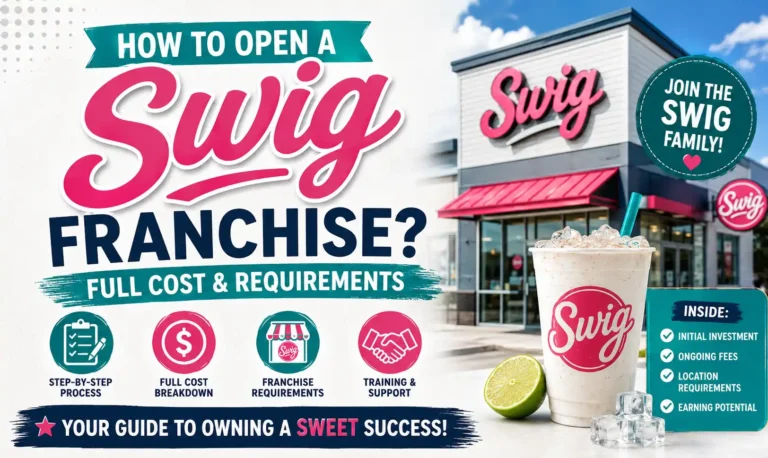
- Total initial investment: roughly $559,000 to $1,981,000 per the 2026 FDD summary, though other 2025–2026 sources cite a range closer to $504,900 to $1,118,000+ depending on location type and market.
- Initial franchise fee: around $39,500, which is non-refundable
- Grand-opening support fee: roughly $10,000, covering travel, lodging, and meals for a two-person corporate support team during a 7-day on-site launch period.
Because these numbers shift as Swig updates its FDD, always request the current document directly from Swig before budgeting for a location.
Who Qualifies to Franchise a Swig?
Swig isn’t a brand for first-time restaurant owners. The company is explicit that it’s looking for seasoned, well-capitalized operators. To be considered, prospective franchisees generally need to:
- Already operate 10 or more quick-service or fast-casual locations (brands like Subway, Sonic, Dutch Bros, or Five Guys are commonly cited as relevant experience.
- Commit to developing a minimum of 10 Swig locations, opening 2 to 3 new stores per year.
- Demonstrate strong performance metrics, including 4-star-plus online reviews across existing brands and positive references from current franchisors.
- Bring local real estate expertise to secure high-traffic sites.
This isn’t a casual side-business opportunity — it’s built for multi-unit restaurant groups looking to add a fast-growing beverage brand to their portfolio.
Where Is Swig Expanding as a Franchise?
Swig’s 2026 franchise deals show a clear pattern: the company is prioritizing experienced multi-unit groups to fuel rapid, regional growth. Recent signed agreements include:
- Chicago, Illinois — a 13-unit development agreement with husband-and-wife operators Derek and Michelle Hincks, covering suburbs including Naperville, Crest Hill, Joliet, and Bolingbrook, with the first store opening in August 2026.
- Colorado Springs, Colorado — a 10-location franchise agreement marking Swig’s first entry into Colorado, led by father-son operators Alex and Alan Knox.
- Southern Florida — a 25-unit franchise development deal covering Port St. Lucie, Palm Beach, and Stuart, signed with veteran multi-unit franchisees.
Across these deals, Swig leadership has repeatedly emphasized wanting operators with proven multi-unit experience rather than first-time owners — reinforcing that this is a franchise built for scale, not solo entrepreneurship.
Why Swig’s Franchise Model Works
Swig’s drive-thru-first format is part of what makes it attractive to franchisees. The stores are designed to be small and efficient —as little as 800 to 850 square feet which keeps construction and real estate costs lower than a traditional restaurant. There’s no complex kitchen to build out, which simplifies labor and speeds up how quickly a franchisee can scale across multiple locations.
That efficiency, paired with a loyal, socially engaged customer base built through viral TikTok and Instagram attention, is a big part of why Swig has been able to sign so many large multi-unit deals in a short period.
Swig Franchise: Pros and Cons
Pros
- Strong, loyal customer base with viral social media presence
- Small footprint reduces build-out and real estate costs
- Comprehensive training (roughly 200 pages of operational documentation) and on-site launch support
- Fast-growing category with limited direct competition at national scale
- Backed by an established, well-capitalized parent company (Larry H. Miller Company)
Cons
- High barrier to entry — must already operate 10+ QSR locations
- Steep total investment, potentially exceeding $1.9 million
- Requires committing to 10+ units and an aggressive 2-3 stores per year build-out pace
- Franchise fee ($39,500) is non-refundable
- Ongoing operational updates may require additional capital investment
Myth vs. Fact
Myth: “Swig is 100% franchised, like most fast-food chains.” Fact: Swig still operates a significant number of company-owned locations alongside its franchised units. As of 2026, company-owned stores outnumber franchised ones.
Myth: “Anyone can apply to open a Swig.” Fact: Swig specifically targets experienced multi-unit restaurant operators, not individual first-time franchisees.
Myth: “Franchised Swig locations are different from corporate ones.” Fact: Menu, branding, and store design are standardized across both franchised and corporate-owned locations — the difference is in who owns and operates the store, not what you experience as a customer.
You May Also Like:
FAQs
Is Swig a franchise?
Yes. Swig launched its franchise program in 2023 and now operates both franchised and corporate-owned locations across 16+ states.
When did Swig start franchising?
Swig began franchising in 2023, opening its first franchised location in Rogers, Arkansas, that same year.
How much does it cost to open a Swig franchise?
Reported total investment figures range from roughly $504,900 to as much as $1.98 million, depending on the source, market, and store type. The exact figure depends on the current Franchise Disclosure Document.
Is the Swig franchise fee refundable?
No. The initial franchise fee (around $39,500) is non-refundable.
Who owns Swig?
Swig is majority-owned by the Larry H. Miller Company, with the Savory Fund holding a minority interest.
Can a first-time business owner franchise a Swig?
It’s unlikely. Swig’s stated preference is for operators who already run 10 or more quick-service or fast-casual locations.
How many Swig locations are franchised vs. corporate-owned?
As of 2026, reported figures show 43 franchised units and 99 company-owned units, though this ratio is shifting as new franchise deals are signed.
How many total Swig locations are there?
Swig has more than 150 locations across 16 U.S. states as of mid-2026.
What states is Swig expanding into as a franchise?
Recent franchise development deals cover Illinois (Chicago suburbs), Colorado (Colorado Springs), and Florida (Port St. Lucie, Palm Beach, Stuart), among other markets.
Does Swig require franchisees to open multiple locations?
Yes. Swig typically requires a minimum development commitment of 10 locations, opening at a pace of 2-3 new stores per year.
What is Swig’s minimum store size?
Swig locations can operate in spaces as small as 800 to 850 square feet, thanks to its drive-thru-focused format.
Is Swig the same as other dirty soda brands like Sodalicious or Fiiz?
No. Swig is a separate company and was involved in a 2015 trademark dispute with competitor Sodalicious over use of the term “dirty soda.” Each dirty soda brand has its own ownership and franchise structure.
Does Swig offer more than dirty sodas?
Yes. Along with customizable dirty sodas, Swig sells water-based Refreshers, customizable energy drinks called Revivers, cookies, and pretzel bites.
How do I apply to franchise a Swig?
Prospective franchisees can submit an inquiry through Swig’s official franchising page, after which the company reviews experience and financial qualifications before moving to a formal Franchise Disclosure Document and agreement.
Is Swig a publicly traded company?
No. Swig is privately held, majority-owned by the Larry H. Miller Company.
Bottom Line
Swig is a franchise — but a selective one. After more than a decade as a purely corporate chain, the brand opened its franchise program in 2023 and has since signed major multi-unit development deals across the country. If you’re a customer, it doesn’t matter much whether your local Swig is franchised or corporate-owned — the menu and experience are the same either way.
But if you’re considering ownership, know that Swig is built for experienced, well-capitalized multi-unit operators, not first-time entrepreneurs.
For the most current investment figures, unit counts, and territory availability, request Swig’s latest Franchise Disclosure Document directly from the company at its official franchising page before making any decisions.